Vacations For Less Destination Weddings
Destination Wedding Travel Planning for Less
Vacations For Less Destination Weddings
Destination Wedding Travel Planning for Less
Ultimate Travel Destination Wedding Blog: Top Venues, Resorts, and Tips
How to Plan a Destination Wedding: The Complete 2026 Timeline
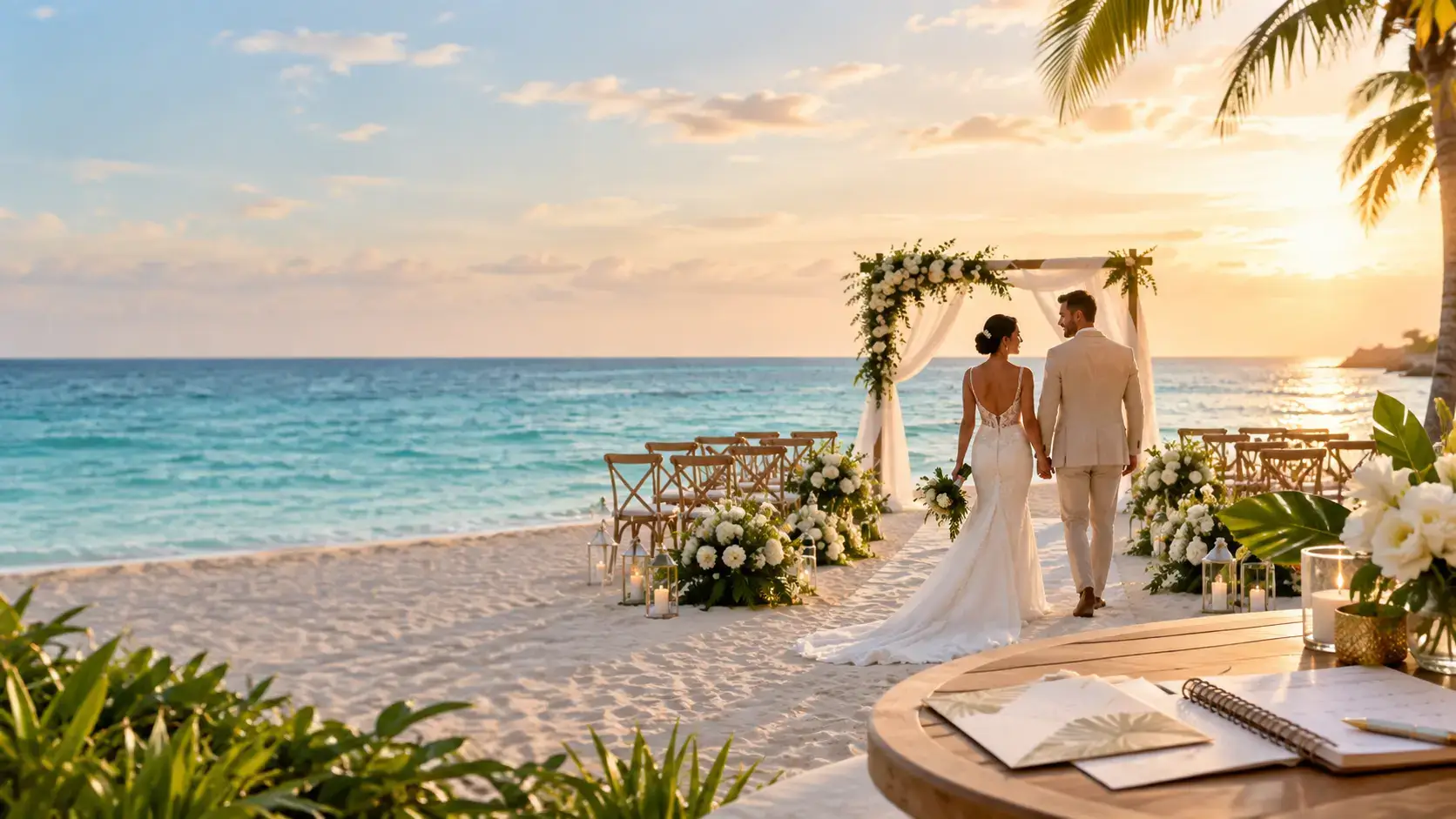
Planning a destination wedding follows a different rhythm than a local one — guest travel time, resort group-contract deadlines, and legal document timelines all move at their own pace, and missing one can mean losing your date or your preferred package tier. This timeline lays out exactly what to handle and when, from the day you pick a destination through the final week before you fly out — built around the real booking windows VFL sees across Mexico and the Caribbean, not a generic wedding-blog checklist.
Updated September 2026 · Destination Wedding Planning · CST #2002477-40
Why Destination Wedding Timelines Work Differently
A local wedding timeline is built around vendor availability. A destination wedding timeline is built around three things instead: how far out your guests need notice to book flights and time off work, when the resort needs your group's room block and final headcount locked in, and how long your chosen country's legal marriage paperwork takes to process. Get those three right and the rest — décor, menu, photography — slots in around them.
The Complete Timeline
- Pick your destination and rough date. Season affects both weather and pricing — see each destination's climate section before locking a month.
- Set a realistic budget range. Know your guest count target before you shop packages — package tiers and free-package thresholds are guest-count-driven.
- Work with a destination wedding specialist (like VFL) rather than researching resort-by-resort alone — a specialist has access to group rates and current promotions that aren't published publicly.
- Decide legal vs. symbolic early. This affects your document timeline and, in some destinations, your total cost — see the Legal vs. Symbolic section below.
- Sign the resort's group contract and open your room block — this is what unlocks group benefits and complimentary-package eligibility, and it's the single most time-sensitive step in the whole timeline.
- Select your wedding package tier based on your guest count and must-have inclusions.
- Send a "save the date" so guests can begin planning time off and watching for flight deals.
- If your package tier is a flagship or signature experience (a private yacht ceremony, for example), confirm booking-window requirements now — some require 1 year or more advance notice.
- Send formal invitations with a firm RSVP deadline — destination weddings need more guest lead time than local ones, and a later invitation squeezes your final headcount deadline.
- Start legal document preparation if pursuing a legal ceremony — birth certificates, apostilles, and translations can take weeks to months depending on destination.
- Book your officiant if using an outside officiant rather than the resort's included coordinator.
- Begin planning welcome events and group excursions — catamaran tours, group dinners, or a rehearsal dinner beyond the resort's basic package.
- Track RSVPs against your room block — this is when most couples discover they're short of or over their qualifying room count for a complimentary package.
- Schedule cake and menu tastings if available at your resort, and finalize any upgraded floral or décor add-ons.
- Book attire, alterations, and hair/makeup trials — factor in extra time if traveling with a dress that needs steaming or a trial that has to happen before travel.
- Apply for your marriage license if pursuing a legal ceremony — most destinations require this closer to travel, not earlier, since licenses have a limited validity window.
- Confirm travel insurance for the couple and consider recommending it to guests, especially during hurricane season destinations.
- Submit your final guest count and rooming list to the resort — this is usually the hard deadline that determines your final package cost, including any extra-guest fees.
- Finalize ceremony and reception details with your on-site coordinator — timeline, décor placement, music, seating.
- Complete final payments per your resort's payment schedule.
- Plan the rehearsal dinner or welcome event in detail, and confirm any group excursions with final headcounts.
- Reconfirm every vendor and resort detail one last time — ceremony time, venue, package inclusions, and any special requests.
- Pack essentials separately — legal documents, marriage license paperwork, rings, and attire should travel as carry-on, never checked luggage.
- Coordinate arrival timing with your group where possible — arriving even a day ahead of most guests gives you buffer time to meet with your on-site coordinator before the week gets busy.
- Meet with your on-site wedding coordinator as early as possible after arrival to walk the venue and confirm every detail in person.
Legal vs. Symbolic — Why This Decision Shapes Your Timeline
Deciding early whether you want a legally binding ceremony abroad or a symbolic celebration (with the marriage legalized separately at home) affects your document deadlines, and in some destinations, your total cost. The Dominican Republic charges a mandatory government surcharge for legal ceremonies; Mexico's requirements vary by state; and document processing times range from days to months depending on where you're marrying. Many couples choose symbolic specifically to simplify this part of the timeline.
Start Your Timeline by Destination
Resort-specific booking windows, package deadlines, and legal quirks vary by destination — dig into the specifics for wherever you're headed:
Frequently Asked Questions
Get Your Personalized Wedding Timeline
Tell us your target date, destination preference, and guest count. We'll map out your exact booking deadlines, legal document timeline, and room-block milestones — free, within 24 hours.
No agency fees · No obligation · Response within 24 hours
Prefer to talk? Call 1-800-200-2423 · Mon–Fri, 9AM–5:30PM PT